01 / the route inspector
different work.
different routes.
Pick a sample request. Inspect the choices behind a single answer.
Extract the invoice number, vendor and total as JSON.

Invoice INV-2048
Acme Studio
Total: USD 840.00
Structured-output support and the quality floor narrow the pool. A single worker is enough for this example.
- quality floor
- medium
- route shape
- w · single worker
- models
- gemini-3.5-flash
- example cost
- $0.0006
{
  "invoice": "INV-2048",
  "vendor": "Acme Studio",
  "total_usd": 840.00
}
Illustrative examples with sample responses and costs. No request is sent to a model. These examples are separate from the measured benchmark below.
02 / follow the request
a route with
a reason.
Follow the selected example from intent to answer. Scroll to move through each decision.
The task sets the floor.
A bounded extraction task. The answer must fit a JSON schema; no planning or external tools are needed.
Capability first. Price next.
Structured-output support and the quality floor narrow the pool. A single worker is enough for this example.
One worker, or a bounded chain.
Gemini 3.5 Flash extracts the three requested fields. One model call, one structured response.
An answer with a decision trail.
Validate the response schema, then return the answer. This low-risk route does not add a separate verifier model.
under the hood: the routing constraints
Deployment, pricing, capabilities and policy checks narrow the eligible pool before selection.
A conservative quality floor comes before savings. An ineligible route is excluded with its reason attached.
At most seven model calls, two parallel workers and one repair round, under a fixed cost ceiling.
28 models. 12 families. 15 open-weight.
Five routing strategies and an open-weights-only switch. Choose the constraints for your workload; the endpoint stays the same.
03 / the decision record
nothing
lost in the
black box.
The features read. The floor set. The models chosen. Every decision joins an append-only, hash-bound record.
illustrative record · selected sample
- 01request receivedextract / invoice
- 02quality floor setmedium
- 03route selectedw · single worker
- 04response checkedschema validated
- 05decision recordedappend-only · hash-bound
04 / measured, openly
the numbers.
all of them.
Four new Hydra runs. Nine historical controls. The same 100 tasks, evaluated with Fable 5.1 low. Explore every result, including the models ahead of Hydra.
Hydra 100% quality
select any configuration below ↘13 / 13
| configurationtasks scored / 100 | quality · 0–100Fable 5.1 low | generation costUSD / 100 planned tasks |
|---|---|---|
| earlier comparison model | 87.95 | $0.114 |
| earlier comparison model | 87.72 | $0.397 |
| new Hydra run | 85.66 | ≥ $0.234 + ? |
| new Hydra run | 85.43 | $0.021 |
| new Hydra run | 85.38 | $0.021 |
| earlier comparison model | 84.43 | $0.187 |
| earlier Hydra run | 84.06 | ≥ $0.040 + ? |
| earlier comparison model | 83.91 | $0.209 |
| earlier Hydra run | 83.13 | ≥ $0.019 + ? |
| earlier comparison model | 82.82 | ≥ $0.147 + ? |
| earlier Hydra run | 82.04 | ≥ $0.100 + ? |
| earlier comparison model | 81.77 | $0.030 |
| new Hydra run | 80.51 | ≥ $0.103 + ? |
≥ + ? and hatching mark a confirmed cost lower bound plus an unknown remainder. Quality bars show means on a 0–100 scale; cost bars use a $0–$0.40 scale. The original chart below includes the descriptive intervals.
how to read these results
Quality. Mean score on a 0–100 scale, judged by Fable 5.1 low; n/100 indicates tasks scored. The source chart reports descriptive 95% bootstrap intervals. This is a repeated internal benchmark, without independent holdout evidence; bootstrap intervals do not measure judge confidence.
Run conditions. New runs: 600 s per attempt, up to 3 initial attempts + 1 targeted recovery. Historical controls did not use this time limit.
Costs. USD for all generation attempts per 100 planned tasks, excluding the judge. Hatched costs are confirmed lower bounds with an unknown remainder.
Comparison limits. Runtime conditions and provider prices differ between waves. These results do not establish a Pareto frontier or a universal cost–quality advantage.
The technical paper. The routing architecture, the evaluation methodology and the full N=100 tables — including the limitations of this benchmark — are written up in our technical white paper.
read the technical paper · PDFview the original benchmark chart (German)
open full-size chart ↗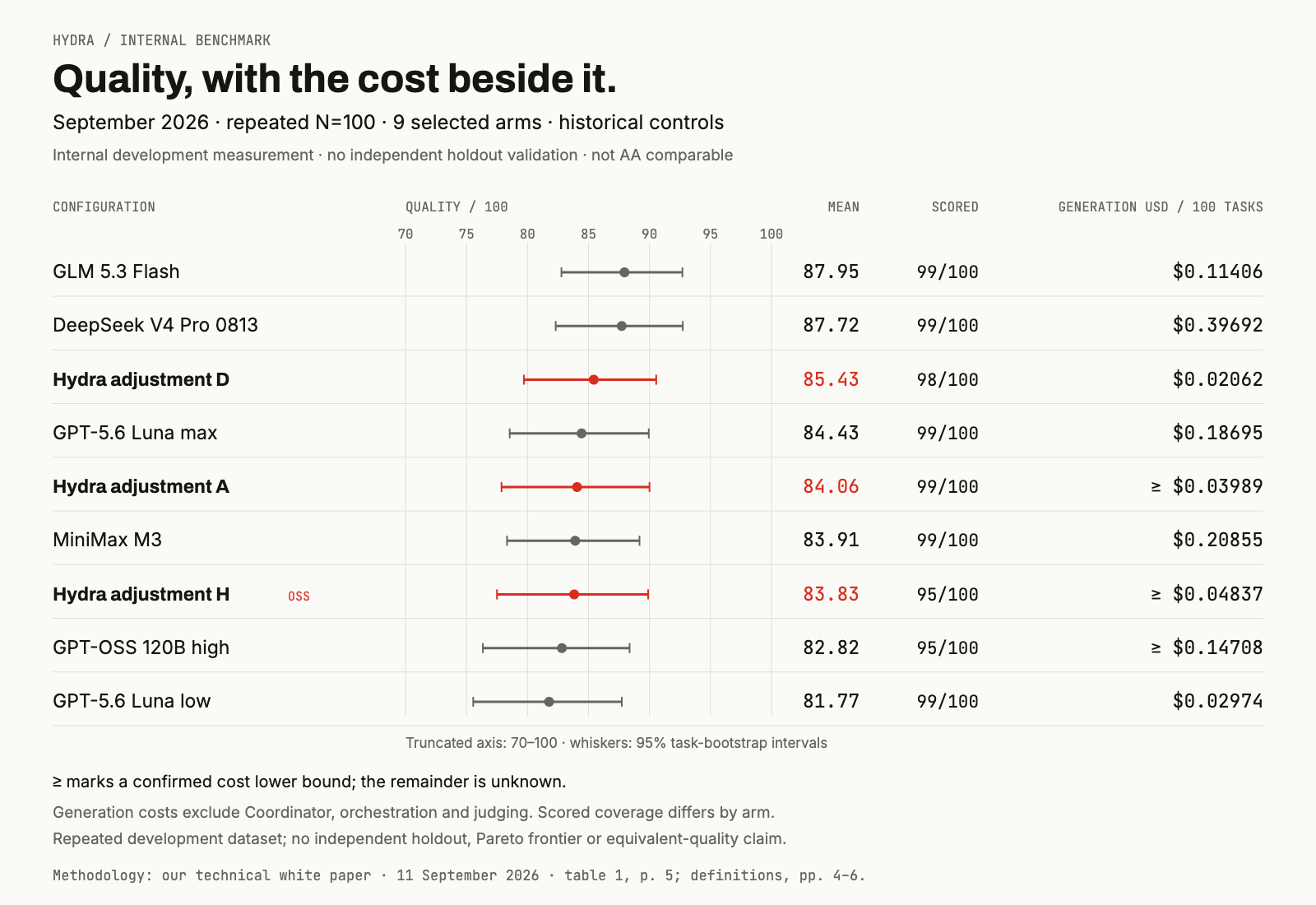
05 / one decision away
new routes.
same stack.
Send a prompt, receive a routing decision, then call the selected model in your own application.
get your access ↗import os
import requests
response = requests.post(
"https://hydraroute.com/v1/answers",
headers={"Authorization": f"Bearer {os.environ['HYDRA_API_KEY']}"},
json={"prompt": "Explain PostgreSQL and SQLite.",
"profile": "balanced", "open_source": False},
timeout=60,
)
response.raise_for_status()
decision = response.json()HYDRA_API_KEY is your console key. Hydra returns a decision; your application runs the model.